OWI Laws in Wisconsin

The Complete Guide to First Offense OWI in Wisconsin (2026)

    Before you go further

    If you or someone you love has been charged with a first OWI in Wisconsin, the decisions you make in the next few days could shape your life for years to come.

    This guide covers everything you need to know: penalties, hidden costs, defense strategies, and the critical deadlines that can make or break your case.

    You have only 30 days after your arrest to request an Administrative Review Hearing or your license will be automatically suspended. Don't wait. Contact Attorney Patrick Stangl now for a FREE 10-minute consultation.

    What is an OWI in Wisconsin?

    OWI stands for "Operating While Intoxicated." It's Wisconsin's official legal term for what many people commonly call drunk driving.

    Under Wisconsin Statute § 346.63(1), no person may drive or operate a motor vehicle while under the influence of an intoxicant, a controlled substance, a controlled substance analog, or any combination thereof that renders them incapable of safely driving.

    An OWI charge can arise from three distinct situations:

    1. Impairment-based (the "A" ticket): The state alleges you were operating a vehicle while impaired by alcohol or drugs, based on officer observations such as erratic driving, slurred speech, bloodshot eyes, or poor performance on field sobriety tests.

    2. BAC-based (the "B" ticket): Your blood alcohol concentration tested at or above the legal limit — 0.08% for most drivers age 21 and older, 0.04% for commercial drivers, and any detectable amount for drivers under 21.

    3. Restricted substance (the "AM" ticket): A restricted controlled substance such as marijuana, cocaine, or methamphetamine was found in your blood. Wisconsin applies a strict "absolute sobriety" standard for restricted controlled substances, meaning any detectable amount can result in a charge regardless of whether you showed signs of impairment.


    In some cases, you may also be charged with Actual Physical Control (APC). The difference is that APC does not require proof that you were actually driving — only that you were in control of the vehicle (for example, sitting in the driver's seat with the keys in the ignition) while under the influence.

    Police can require you to provide a breath, blood, or urine sample to test your BAC. If you refuse, they can obtain a warrant to draw your blood, and you will face additional penalties under Wisconsin's Implied Consent law.

    Facing an OWI charge? Every case has details that could work in your favor. Attorney Patrick Stangl has spent over 35 years identifying those details and using them to protect his clients. 

    New Call-to-action


    OWI vs. DUI vs. PAC — What's the Difference?

    If you have been researching drunk driving charges, you have probably seen the terms OWI, DUI, DWI, and PAC used in various contexts. Here is what each one means and why it matters.

    OWI (Operating While Intoxicated) is the term Wisconsin uses. It is based on evidence that you were impaired by alcohol, drugs, or a combination while operating a motor vehicle.


    DUI (Driving Under the Influence) and DWI (Driving While Intoxicated) are the terms used by other states for essentially the same offense. There is no legal distinction between a DUI and an OWI — they describe the same charge with different names depending on the state.


    PAC (Prohibited Alcohol Concentration) is a separate but related charge specific to Wisconsin. A PAC charge is based solely on having a BAC at or above the legal limit (0.08% for most adults, 0.00% for drivers under 21). Unlike an OWI, a PAC charge does not require evidence of impaired driving — just a test result showing you were over the limit. It is very common for drivers to be charged with both OWI and PAC at the same time, though a conviction on both counts arising from the same incident results in a single conviction for sentencing purposes.

    For a first offense, PAC penalties are identical to OWI penalties.

    Why a First OWI Is NOT "Just a Ticket"

    This is the single most dangerous misconception about a first OWI in Wisconsin. Many people hear that a first offense is "just civil" and assume they can pay a fine and move on. That could not be further from the truth.

    A first OWI conviction can cost you your driver's license for up to nine months, raise your insurance rates for years, require you to install a device in your car that you must blow into before it will start, mandate drug and alcohol assessments and treatment, and leave a permanent mark on your record that cannot be removed.

    Beyond the legal penalties, a first OWI can affect where you work, where you live, whether you can travel internationally, and how you are perceived by employers and licensing boards for the rest of your life.

    The bottom line: a first OWI is one of the most serious legal situations most people will ever face, and it deserves a serious legal response.

    Don't underestimate your first OWI. Attorney Patrick Stangl can help you understand exactly what you are facing and what options exist to fight it.

    New Call-to-action

    Civil vs. Criminal — What That Really Means

    Wisconsin is the only state in the country where a first offense OWI is classified as a civil violation rather than a criminal offense. This classification has both advantages and disadvantages that every defendant should understand.

    • The advantages: You will not face jail time for a standard first offense (no aggravating factors), and it will not appear as a criminal conviction on your Wisconsin record. This can be important for employment and professional licensing.

    • The disadvantages: The infraction still goes on your permanent record, cannot be expunged, and will appear on background checks conducted by employers, licensing boards, and insurers. The penalties (license revocation, fines, mandatory assessments, higher insurance premiums) are still substantial.

    A critical caveat: Because a first OWI is civil and not criminal in Wisconsin, a public defender cannot represent you. You must hire a private attorney to fight your charge. This is not optional — it is a structural feature of Wisconsin's legal system for first offense OWI.

    There is another important implication for anyone who may move out of state: most other states treat a first-offense drunk driving charge as a criminal misdemeanor. Employers, government agencies, and professional licensing boards in those states may interpret your Wisconsin civil OWI as a criminal-level offense, which could limit job opportunities, professional licensing, and even housing applications.

    A first offense OWI also sets a legal precedent. If you are ever arrested again, prosecutors will treat you as a repeat offender, and future charges become criminal with dramatically harsher consequences.

    Standard Penalties for a First Offense OWI in Wisconsin

    Even without aggravating factors, a first offense OWI in Wisconsin carries significant penalties:

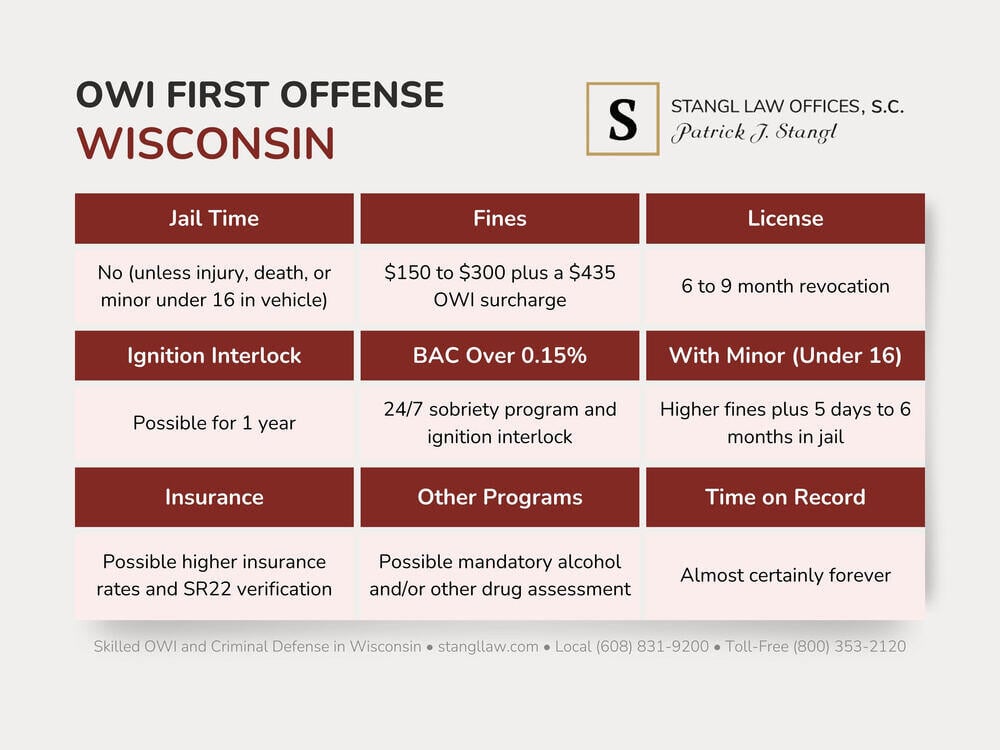
    • Driver's license revocation for 6 to 9 months. During this period, you cannot legally drive unless you obtain an occupational license (see below).

    • Fines between $150 and $300, plus an additional $435 OWI surcharge and court costs.

    • Mandatory Alcohol and Other Drug Assessment (AODA). You must complete this evaluation at a state-approved facility and follow through with whatever treatment is recommended.

    • SR-22 insurance requirement for at least three years after conviction. SR-22 is not a type of insurance — it is a form your insurance company files with the DMV to prove you carry coverage. Expect to pay two to three times your normal insurance premiums during this period.

    • Possible Ignition Interlock Device (IID) if your BAC was 0.15% or higher. You must pay all costs of installing, maintaining, and renting the device, and your legal BAC limit drops to 0.02% while the IID is active.

    • $240 occupational license fee if you need to apply for restricted driving privileges.

    • $200 reinstatement fee to the DMV once your revocation period ends.

     
    These are the minimum penalties. The situation gets significantly worse under several common circumstances.

    First-Offense-OWI-Wisconsin

    When Penalties Get Much Worse

    Several common circumstances can dramatically increase the severity of your first OWI penalties.

    If any of the following apply to your situation, it is especially critical to work with an experienced attorney.

    Excessive BAC (0.15% or Higher)

    If your BAC was 0.15% or higher at the time of your arrest:

    • A mandatory Ignition Interlock Device (IID) must be installed for at least 12 months on every vehicle you own or operate.
    • Your legal BAC limit drops to 0.02% while the IID is active.
    • Fines increase, with BAC-based multipliers at higher levels: fines are doubled for a BAC of 0.17% to 0.199%, tripled for 0.20% to 0.249%, and quadrupled for 0.25% or greater.


    Minor Passenger Under 16

    If a child under 16 was in the vehicle at the time of the offense, the consequences change dramatically:

    • The charge is no longer civil — it becomes a criminal misdemeanor.
    • You face 5 days to 6 months in jail.
    • Fines increase to $350 to $1,100, plus the $435 surcharge.
    • License revocation extends to up to 18 months.
    • IID installation is required for 12 to 18 months.


    OWI Causing Injury

    If your OWI caused injury to another person:

    • The charge becomes a misdemeanor.
    • You face 30 days to 1 year in jail.
    • Fines of up to $2,000.
    • Penalties double if the injured person was under 16 years old.


    OWI Causing Great Bodily Harm or Death

    If your OWI caused great bodily harm:

    • The charge becomes a Class F felony.
    • You face up to 12.5 years in prison.
    • Fines of up to $25,000.
    • Penalties increase if a pregnant woman was in the vehicle.

    If your OWI resulted in someone's death:

    • The charge becomes a Class D felony.
    • You face up to 25 years in prison (up to 40 years if you had a prior OWI).
    • Fines of up to $100,000.
    • Penalties increase if a pregnant woman was in the vehicle.

    Aggravating factors can turn a civil ticket into years in prison. If any of these apply to your case, you need an experienced defense attorney immediately. 

    New Call-to-action

    First Offense OWI Fines: A Full Breakdown

    The court-imposed fines for a first OWI vary based on your BAC level and the circumstances of the offense:

    • Standard first OWI (no aggravating factors): $150 to $300, plus court costs and the $435 surcharge.
    • BAC of 0.15% or higher: $300 to $500 or more, plus mandatory IID costs.
    • BAC of 0.17% to 0.199%: Fines doubled — $300 to $600 or more.
    • BAC of 0.20% to 0.249%: Fines tripled — $450 to $900 or more.
    • BAC of 0.25% or greater: Fines quadrupled — $600 to $1,200 or more.
    • OWI with a child under 16 in the vehicle: $350 to $1,100 or more, plus the $435 surcharge and additional criminal penalties.
    • OWI involving injury: $300 to $2,000 or more.
    • OWI involving great bodily harm: Up to $25,000 (Class F felony).
    • OWI involving death: Up to $100,000 (Class D felony).


    Keep in mind that these fines represent only a small fraction of the total financial impact of a first OWI conviction.

    The True Cost of a First OWI in Wisconsin

    The court-imposed fine of $150 to $300 makes many people think a first OWI is a minor financial hit. In reality, the total cost of a first OWI conviction often exceeds $10,000 when you account for all expenses:

    • Initial fines and surcharges: $700 to $1,000 or more (including the $435 surcharge and court costs).

    • SR-22 high-risk insurance: Your auto insurance premiums can double, triple, or even quadruple. You must maintain SR-22 verification for at least three years, and you will likely pay elevated rates for five years after conviction.

    • Ignition Interlock Device (IID): If required, expect to pay approximately $1,000 or more per year, per vehicle, for installation, rental, and maintenance.

    • Mandatory AODA assessment and treatment: The initial assessment typically costs $275 to $300. If additional counseling, classes, or treatment are recommended, costs can reach thousands of dollars out of pocket.

    • Occupational license fee: $240 to apply for restricted driving privileges.

    • License reinstatement fee: $200 to the DMV once your revocation period ends.

    • Towing and impound fees: These vary but can add hundreds of dollars.

    • Transportation costs during license suspension: Rideshare services, taxis, and other alternatives add up quickly over 6 to 9 months without a license.

    • Lost wages: Time away from work for court appearances, assessments, and treatment sessions.


    When you add it all up, a first OWI is one of the most expensive legal situations most people will ever face.

    An experienced OWI attorney can often reduce these costs dramatically by getting fines reduced, IID requirements waived, or charges dropped entirely. The cost of hiring an attorney is almost always less than the cost of a conviction. 

    New Call-to-action

    License Suspension and Revocation

    For most people, losing the ability to drive is the hardest part of a first OWI. Without a license, you cannot legally drive to work, take your children to school, or handle basic daily needs.

    If You Took the Breath or Blood Test

    If you took the test and your BAC was 0.08% or higher, you will receive a Notice of Intent to Suspend. Your license will be suspended 30 days from the date on the notice. The standard suspension period is 6 to 9 months.

    If your BAC was 0.15% or higher, you will also be required to install an IID, even for a first offense.

    If your BAC was below 0.08%, you may avoid an automatic suspension, but the state can still pursue the OWI charge based on officer observations of impairment.

    If You Refused the Test

    If you refused a breath, blood, or urine test, you will receive a Notice of Intent to Revoke. Revocation is more severe than suspension — your license will be revoked for at least one year for a first refusal. Additional consequences include a mandatory AODA assessment and the possibility of an IID or court-ordered sobriety program.

    Refusal penalties increase for repeat situations: two years for a second refusal within 10 years, and three years for a third refusal within 10 years.

    The 30-Day Deadline: Why It Matters

    Whether you took the test or refused, the Notice of Intent you received starts a 30-day clock. If you do not request an Administrative Review Hearing within that window, your license will be automatically suspended or revoked — even before your court date.

    Requesting an administrative hearing is one of the most important steps you can take. It gives you the opportunity to fight for your license so you can keep driving while your case is pending. More importantly, it gives your defense attorney the chance to cross-examine the arresting officer, review the state's evidence, and identify errors in the stop, testing, or procedures.

    When errors are exposed, critical evidence can be thrown out, charges can be reduced, and in some cases the entire case can be dismissed.

    You do not need to appear at the hearing personally — your attorney can attend on your behalf. There is no downside to requesting it, and the potential upside is enormous.

    The 30-day clock is already ticking. Contact Attorney Stangl immediately to request your Administrative Review Hearing and protect your driving privileges.

    New Call-to-action

    Can You Still Drive? Occupational Licenses Explained

    An occupational license is a restricted license issued by the Wisconsin Department of Transportation that allows you to drive for essential purposes after your regular license has been suspended or revoked. It is designed to help you maintain necessary responsibilities while limiting your overall driving privileges.

    What You Can Drive For

    An occupational license permits driving for employment, school, medical care, childcare, household duties, and religious obligations. Driving is restricted to no more than 12 hours per day and 60 hours per week.

    How to Get One

    To obtain an occupational license, you must:

    1. Pay the $240 occupational license fee.
    2. Show proof of SR-22 insurance.
    3. Complete your alcohol and drug assessment.


    If your BAC was below 0.15%, you can apply immediately and an IID is not required (unless the court orders one).

    If your BAC was 0.15% or higher, you must show proof of IID installation on every vehicle you own or operate before your occupational license will be granted.

    In most cases, the sooner you complete these steps, the sooner you can legally drive again.

    Ignition Interlock Device (IID) Requirements

    An Ignition Interlock Device (IID) is a small breath-testing machine installed in your vehicle's ignition system. Before the car will start, you must blow into the device. If alcohol is detected, the vehicle will not start. The device also requires periodic retests while driving.

    When an IID Is Required for a First Offense

    An IID is automatically required if your BAC was 0.15% or higher or if you refused a chemical test. In these cases, the device must be installed on every vehicle you own or operate, you can only drive IID-equipped vehicles, you are responsible for all costs, and the order lasts at least 12 months (though the court may impose a longer period).

    If your BAC was below 0.15%, an IID is not automatically required. However, the court has discretion to order one based on the circumstances of the case, such as an accident, an injury, or other aggravating factors.

    IID Costs

    Expect to pay approximately $1,000 or more per year, per vehicle, for IID installation, monthly rental, calibration, and maintenance. While the device is active, your legal BAC limit drops to 0.02%.

    Alcohol and Other Drug Assessment (AODA)

    Every person convicted of a first OWI in Wisconsin must complete an Alcohol and Other Drug Assessment (AODA). This is a court-ordered evaluation conducted by a state-approved treatment facility, typically costing $275 to $300 or more.

    The purpose of the assessment is to review your history with alcohol or drug use and determine whether additional classes, counseling, or treatment are needed before you can reinstate your driver's license.

    • If your BAC was below 0.15%, courts generally limit follow-up to whatever the assessment recommends.

    • If your BAC was 0.15% or higher, courts often view the elevated level as a more serious concern and may order extended counseling, classes, or monitoring beyond what the assessment recommends.

    You must complete the AODA and any required follow-up treatment before your license can be reinstated.

    The Hidden Long-Term Consequences of a First OWI

    Most people focus on the immediate penalties — fines, license suspension, and the IID, but the long-term consequences of a first OWI conviction are often far more damaging.

    • Employment: A first OWI can affect your ability to get or keep a job, especially in fields that involve driving, government positions, healthcare, education, finance, or any role requiring a background check. Many employers run background checks, and a first OWI can still appear and be treated as a serious offense. Even if your job does not require driving, many companies prohibit employees with an OWI from driving company vehicles.

    • Professional licensing: Teachers, nurses, pilots, commercial drivers, and certain trades that require professional licenses may face additional consequences including license review, suspension, or denial.

    • Housing: Many landlords run background checks and may deny applications from individuals with impaired driving convictions.

    • International travel: An OWI conviction can complicate entry to other countries, especially Canada, where impaired driving is treated as a serious criminal offense and can be grounds for denial of entry.

    • Insurance: Beyond the SR-22 requirement, your overall insurability can be affected for years. Some insurance companies will drop you entirely.

    • Education: If you are a college student, an OWI conviction could affect scholarships, campus housing eligibility, and future career opportunities.

    • Family law: An OWI can be raised in child custody proceedings and may affect adoption applications.

    • Future OWI charges: Wisconsin uses a lifetime look-back period, meaning your first OWI will count against you forever if you are ever charged again. A second offense becomes criminal with mandatory jail time.

    These consequences are real, but they only apply if you are convicted. An experienced attorney can fight to prevent a conviction from ever reaching your record.

    New Call-to-action

    How Long Does a First OWI Stay on Your Record?

    In Wisconsin, a first OWI stays on your driving record and arrest record permanently. It cannot be removed. Period.

    Wisconsin uses a lifetime look-back period for OWI sentencing, which means any prior OWI can be used to increase penalties for a new offense, no matter how many years have passed.

    Your OWI record does not stay only in Wisconsin. It can follow you to other states through national databases and can show up in background checks for employment, housing, professional licensing, and more.

    The only way to protect your record is to fight the charge before a conviction is entered. Once you are convicted, there is no going back.

    Can an OWI Be Expunged in Wisconsin?

    In practical terms, no. Getting an OWI expunged in Wisconsin is next to impossible, and even in the extremely rare case that a court grants expungement, the Wisconsin Department of Transportation does not recognize it. This means the OWI conviction will remain on your driving record forever regardless of whether a court expunges it from your criminal record.

    The bottom line: do not count on expungement under any circumstances. It is far smarter and far more effective to work with an experienced attorney to fight the OWI charges and seek to have them reduced or dismissed before a conviction ever occurs.

    Your best chance at keeping your record clean is right now — before conviction. Contact us to get the expert help you need.

    New Call-to-action

    Special Situations

    Let's run through a few of the unique situations that can complicate a first OWI in Wisconsin.

    First OWI With an Out-of-State Driver's License

    If you receive a first OWI in Wisconsin and hold a driver's license from another state, you will likely face penalties in both Wisconsin and your home state. Wisconsin will impose its own fines, license revocation, AODA assessment, and other requirements. Your home state can then add additional consequences such as suspending your license, adding points to your driving record, requiring classes, and raising your insurance rates.

    States share OWI information through national databases and interstate compacts, making it very rare for a conviction in Wisconsin to go unnoticed by your home state.

    For example, if you hold a Minnesota license, Minnesota can add its own license suspension, plate impoundment, mandatory IID requirements, and higher insurance costs on top of Wisconsin's penalties. If you hold an Illinois license, Illinois can impose a one-year license suspension, points on your record, and mandatory alcohol education classes.

    First OWI for CDL (Commercial Driver's License) Holders

    CDL holders face uniquely harsh consequences for a first OWI. The BAC threshold for commercial vehicle operation is only 0.04% — half the standard limit. Even if the OWI occurred in your personal vehicle at the 0.08% threshold, the conviction triggers CDL penalties.

    A first OWI results in a mandatory one-year CDL disqualification regardless of whether the offense happened in a commercial or personal vehicle. If hazardous materials were being transported, the disqualification increases to three years.

    The career impact is devastating. CDL disqualification almost always means losing your current job, and many carriers refuse to insure or hire a driver with an OWI on their record.

    First OWI for Drivers Under 21

    Wisconsin applies an absolute sobriety rule for drivers under 21, meaning any detectable amount of alcohol in your system is illegal.

    In addition to the standard penalties, underage drivers face a minimum $200 fine, an automatic three-month license suspension, and two separate citations (OWI and PAC). Demerit points, dramatically higher insurance costs, and potential impacts to scholarships, college applications, and future employment make an underage OWI especially consequential.

    OWI for Drugs (Not Alcohol)

    You do not need to be under the influence of alcohol to be charged with an OWI in Wisconsin.

    Under Wisconsin Statute § 346.63(1)(am), any detectable amount of a restricted controlled substance in your blood — including marijuana, cocaine, methamphetamine, heroin, opioids, and certain prescription medications — can result in an OWI charge.

    This strict "absolute sobriety" standard applies regardless of whether you showed any signs of impairment. The penalties are identical to alcohol-related OWI, with additional severity for aggravating factors.

    Special situations require specialized defense strategies. Attorney Stangl has handled every type of OWI case across Wisconsin. 

    New Call-to-action

    What to Do in the First 72 Hours After an OWI Arrest

    The days immediately following your arrest are the most important. What you do — or fail to do — during this window can directly impact the outcome of your case.

    • Immediately after the arrest: Do not discuss your case with law enforcement or the prosecutor beyond providing basic identifying information. Do not try to explain or justify what happened. Anything you say can be used against you.

    • Within 24 hours: Write down everything you remember about the traffic stop, field sobriety tests, and every interaction with police. Record the time, location, weather conditions, road conditions, and any details about the officer's behavior, questions, and instructions. These details may seem insignificant now, but they can become major legal defenses later.

    • Within 30 days of receiving your Notice of Intent to Suspend or Revoke: Request an Administrative Review Hearing with the Wisconsin DMV. If you miss this deadline, your license will be automatically suspended, even before your court date. This is a hard deadline; there are no extensions.

    • As soon as possible: Contact an experienced OWI attorney. The earlier an attorney is involved, the more opportunities exist to challenge the stop, the evidence, and the testing procedures. Evidence can degrade or become unavailable over time, and certain legal motions have strict filing deadlines.

    Time is your most valuable resource right now. Attorney Patrick Stangl has helped clients across Wisconsin take the right steps in those critical first days.

    New Call-to-action

    Why Many First OWI Cases Are Winnable

    A first OWI charge may feel overwhelming, but it is not an automatic conviction. The state must prove every step of the process was conducted correctly, and there are many points where errors commonly occur.

    Law enforcement officers must follow precise procedures at every stage — from the initial traffic stop through field sobriety testing through chemical testing through evidence handling. A single procedural failure can result in evidence being thrown out, charges being reduced, or the entire case being dismissed.

    A successful defense may challenge whether:

    • The traffic stop was lawful and supported by reasonable suspicion.
    • Field sobriety tests were administered correctly and recorded properly.
    • Testing equipment was properly calibrated, certified, and operated according to state regulations.
    • Blood or breath samples were collected, handled, and stored in compliance with required procedures.
    • Officers followed proper protocol, including advising you of your rights.
    • The prosecution can establish an uninterrupted chain of custody for any sample taken.

    Any failure in these steps — and failures are more common than most people realize — can lead to a favorable outcome for the defendant.

    Common Defenses for a First OWI Charge

    The best way to understand whether your specific charge can be reduced or dropped is by speaking with an experienced attorney about the details of your arrest. Below are some of the most commonly used and effective defense strategies in Wisconsin OWI cases.

    1. Illegal Traffic Stop

    The Fourth Amendment requires law enforcement to have reasonable suspicion to stop your vehicle. If the officer did not have legally sufficient grounds for the stop, any evidence gathered afterward — including breathalyzer and blood test results — may be inadmissible. Even if you were stopped legally, the stop can become illegal if the officer extended its scope or duration beyond the original purpose.

    2. Improperly Conducted Field Sobriety Tests

    Field sobriety tests must follow strict standardized protocols established by the National Highway Traffic Safety Administration (NHTSA). If the officer did not administer, demonstrate, or evaluate the tests properly, the results can be challenged and rendered inadmissible. These tests are also inherently subjective, and medical conditions, physical limitations, uneven pavement, poor lighting, weather conditions, and footwear can all affect performance.

    3. Flawed or Mishandled BAC Testing

    Whether your BAC was measured by breath test or blood draw, precise professional standards must be followed at every step — from equipment calibration and certification through sample collection, handling, storage, and analysis. Breath testing devices must be properly calibrated and maintained on a regular schedule. Blood samples must be collected, labeled, stored, and tested in accordance with strict chain-of-custody protocols. Any deviation from these standards can make the test results inadmissible.

    4. The Rising BAC ("Curve") Defense

    Your blood alcohol level continues to rise after you stop drinking because it takes time for alcohol to be fully absorbed into the bloodstream. In some cases, an attorney can successfully demonstrate that you were not over the legal limit while you were actually driving and that your BAC only exceeded 0.08% after the traffic stop, during the time between the stop and the administration of the test.

    5. Medical Conditions

    Certain medical conditions can cause symptoms that mimic intoxication — including diabetes, neurological disorders, gastroesophageal reflux disease (GERD), and certain medications. These conditions can affect field sobriety test performance and, in some cases, breathalyzer readings.

    6. Improper Communication With the Defendant

    If a prosecutor attempted to contact you without an attorney present, and you had not waived your Miranda rights, any statements you made may be inadmissible. If you requested an attorney, no interrogation can take place without your attorney present.

    7. Failure to Provide an Independent Test

    Under Wisconsin law, you have the right to request an independent chemical test after arrest. If the arresting officer failed to provide this opportunity, it can be grounds for dismissal.

    8. Equipment and Procedural Errors

    Incorrectly calibrated BAC instruments, use of unapproved equipment, improperly maintained testing devices, and other technical failures can all provide grounds for challenging the state's evidence, even if you failed a breathalyzer test.

    The details of your arrest matter — a lot. Attorney Stangl has spent over 35 years finding the procedural errors and constitutional violations that lead to reduced or dismissed charges.

    New Call-to-action

    Common Misconceptions About First Offense OWI

    "A first OWI is no big deal." A first OWI conviction is one of the most serious legal events most people will ever experience. Beyond immediate penalties, it can cost you job opportunities, restrict international travel, raise your insurance for years, and stay on your record permanently. Despite being classified as civil in Wisconsin, many employers and entities treat it as a criminal conviction.

    "A first OWI isn't that expensive." The court fine of $150 to $300 is misleading. When you add up surcharges, court costs, mandatory assessments, treatment, SR-22 insurance, potential IID costs, towing fees, transportation costs during suspension, and reinstatement fees, the total frequently exceeds $10,000.

    "I can't be convicted if my BAC was below 0.08%." This is false. If the court determines you were incapable of safely driving while under the influence of any amount of alcohol — even 0.01% — you can face the same penalties as someone over the legal limit. The legal limit is not a safe harbor.

    "You can't go to jail for a first OWI." You can if there was a minor under 16 in the vehicle, if the OWI caused injury or death, or in certain other aggravating circumstances. In the most serious cases, a first OWI can result in decades in prison.

    "I can't get an OWI for drugs." Wisconsin law treats drug-impaired driving the same as alcohol-impaired driving. Any detectable amount of a restricted controlled substance — including marijuana, cocaine, and many other drugs — can result in an OWI charge.

    "A public defender can represent me." Because a first OWI is a civil offense in Wisconsin, you are not entitled to a public defender. You must hire a private attorney.

    "I'll just get it expunged later." OWI expungement in Wisconsin is virtually impossible, and even if granted, the DOT will not remove the conviction from your driving record. The time to fight is before conviction, not after.

    "I don't need a lawyer — I'll handle it myself." A first OWI conviction stays on your record for life, cannot be expunged, and can have cascading effects on your employment, insurance, travel, and personal life. An experienced attorney can challenge the stop, the evidence, and the procedures to pursue reduction or dismissal. Handling it yourself is a risk that is simply not worth taking.

    Frequently Asked Questions

    What is Implied Consent in Wisconsin? Wisconsin is an "implied consent" state. By operating a motor vehicle on Wisconsin roads, you have implicitly consented to chemical testing (breath, blood, or urine) if law enforcement has probable cause to believe you are operating while intoxicated. Refusing the test does not prevent an OWI charge — it results in additional penalties, including a longer license revocation and possible IID requirements.

    Can I refuse a breathalyzer or blood test? You can refuse, but doing so triggers its own set of penalties. Refusing a field sobriety test does not carry additional charges. However, refusing a breath or blood test results in license revocation for at least one year, mandatory AODA assessment, potential IID requirement, and fines. Officers can also obtain a warrant to draw your blood over your objection.

    Is a first OWI a felony in Wisconsin? In most cases, no — a first OWI is a civil infraction. However, it becomes a criminal misdemeanor if a child under 16 was in the vehicle, and it becomes a felony if the OWI caused great bodily harm (Class F felony) or death (Class D felony).

    Do first-time OWI offenders go to jail in Wisconsin? Not for a standard first offense without aggravating factors. Jail time becomes possible (and in some cases mandatory) when a minor was in the vehicle, when injury or death resulted, or when certain other aggravating circumstances apply.

    How long will a first OWI affect my insurance rates? You must maintain SR-22 verification for at least three years after conviction, and you will likely pay elevated insurance premiums for approximately five years.

    What is a Notice of Intent to Suspend or Revoke? This is a document issued by the arresting officer after an OWI arrest. It informs you that your license will be suspended (if you took the test) or revoked (if you refused) 30 days from the date on the notice. You must request an Administrative Review Hearing within that 30-day window or the suspension or revocation becomes automatic.

    Can first OWI charges be reduced or dismissed? Yes. There are proven defense strategies and circumstances that can lead to charge reduction or dismissal. Illegal stops, improperly conducted tests, mishandled evidence, equipment failures, and procedural violations can all result in favorable outcomes. The key is to work with an experienced attorney who knows where to look.

    Will a first OWI affect my ability to travel internationally? It can, particularly with respect to Canada, which treats impaired driving as a serious criminal offense and can deny entry to individuals with OWI convictions on their record.

    What is the difference between suspension and revocation? Revocation is more severe. When your license is suspended, your driving privileges are temporarily withdrawn but your license remains valid once the suspension period ends. Revocation means your license is actually cancelled, and you must go through a reinstatement process and pay the $200 fee before you can drive legally again.

    How much alcohol does it take to be over the limit? The legal BAC limit is 0.08% for most drivers over 21. How quickly you reach that level depends on your weight, gender, metabolism, rate of consumption, and whether you have eaten. On average, it may take as few as one to two drinks in an hour for an adult to reach the legal limit. However, there is no safe or reliable number of drinks — and you can be convicted even below 0.08% if the court determines you were impaired.

    Why You Need an Experienced OWI Defense Attorney

    A first OWI is too serious to handle on your own, and too consequential to trust to a discount attorney who may simply pressure you into a plea deal that leaves a permanent conviction on your record.

    There are several critical reasons why hiring an experienced OWI defense attorney is essential:

    • Public defenders cannot represent you. Because a first OWI is a civil offense in Wisconsin, you are not entitled to a public defender. Without a private attorney, you are on your own against the full resources of the prosecution.

    • The stakes are permanent. A first OWI conviction cannot be removed from your record. It will affect employment, insurance, travel, and future legal proceedings for the rest of your life. You get one chance to fight this — right now.

    • Experience matters. An experienced OWI attorney knows how to identify weaknesses in the prosecution's evidence, from the legality of the traffic stop through the administration of field sobriety tests through the handling of chemical test results. A skilled attorney knows where mistakes are commonly made and how to use those mistakes to your advantage.

    • Outcomes differ dramatically. The difference between an experienced OWI defense attorney and a bargain option can be the difference between dismissal and a permanent conviction. Between keeping your license and losing it. Between protecting your career and watching opportunities disappear.

    What to Expect When Working with Stangl Law

    Attorney Patrick Stangl has over 35 years of experience defending OWI cases across Wisconsin, with a proven record of success in both State and Federal Courts. Here is how Stangl Law approaches your case:

    1. Initial consultation and case review. You will discuss the specifics of your situation, have the charges explained, and hear an honest assessment of your defense options — tailored to your circumstances.

    2. Administrative Hearing (DOT Hearing). Stangl Law immediately requests this hearing to challenge the license suspension and preserve your driving privileges. This step is time-critical and cannot be delayed.

    3. Comprehensive investigation. Attorney Stangl obtains and analyzes all evidence, including police reports, dashcam and bodycam video, test results, equipment calibration records, and officer training records — looking for any violations of your rights or deviations from required procedure.

    4. Filing motions to protect your rights. If violations or inaccuracies are found, strategic motions are filed to suppress unlawful evidence. Many cases are resolved favorably at this stage through reduction or dismissal.

    5. Plea negotiations and strategy. While Wisconsin limits plea bargaining for OWI, Stangl Law works to secure the best possible outcome given the evidence and circumstances.

    6. Court preparation and trial representation. If your case proceeds to trial, you are represented by an attorney with decades of courtroom experience who knows how to present a strong, compelling defense.

    7. Post-resolution support. Stangl Law helps you secure an occupational license and navigate the reinstatement process, ensuring you can return to your life with as little disruption as possible.

    Attorney Patrick Stangl has been fighting OWI charges in Wisconsin since 1991. He has seen every type of case, every prosecutorial strategy, and every procedural error the state can make. When your future is on the line, experience is the only thing that matters.

    New Call-to-action

    Request Your FREE 10-Minute Consultation

    If you are facing a first offense OWI in Wisconsin, the single most important thing you can do right now is talk to an experienced attorney. Not tomorrow. Not next week. Now.

    The 30-day window for requesting your Administrative Review Hearing may already be shrinking. Evidence can degrade. Legal options can expire. The decisions you make in the next few days will shape the outcome of your case.

    Attorney Patrick Stangl offers a FREE 10-minute consultation — no obligation — to discuss the specifics of your case and help you take the first step toward protecting your license, your record, and your future.

    Whether in person, over the phone, or online, this initial conversation can help you understand your situation, your options, and what comes next.

    New Call-to-action

    Stangl Law Offices, S.C. — Madison, Wisconsin Defending clients across Wisconsin since 1991 Over 35 years of experience fighting OWI charges


    Disclaimer: This guide is provided for informational purposes only and does not constitute legal advice. Every OWI case is unique, and outcomes depend on the specific facts and circumstances involved. If you are facing OWI charges, you should consult with a qualified attorney to discuss your individual situation. Contact Stangl Law for a free consultation.

    Helping Clients Move Past Drunk Driving Charges

    In addition to his winning record, awards, and other honors, Attorney Stangl takes great satisfaction in providing his clients with one-on-one attention to build a thorough defense as they fight to overcome challenges brought on by drunk driving charges and move on with their lives.

    If you need a Madison OWI lawyer who is committed to fighting for you, Attorney Stangl is happy to offer a free 10-minute consultation to discuss your case and explore options for your defense.

    Four Consecutive Jury Victories

    For the fourth time in a row, a jury has refused to convict Attorney Stangl's client of Operating While Under the Influence of an Intoxicant (OWI). A St. Croix county jury sitting in Hudson, Wisconsin has found Attorney Stangl's client not guilty of OWI. His client was also charged with Operating With a Prohibited Alcohol Concentration (PAC).

    The above the legal limit or Operating with a Prohibited Alcohol Concentration charge (PAC) was dismissed by the trial court after the conclusion of the State's evidence on Attorney Stangl's motion.

    The court agreed there was insufficient evidence to support a conviction on the PAC charge, because the State failed to produce expert testimony establishing the relevance of the blood test result given the fact it had not proven the time of the alleged operating/driving of his client's vehicle.

    The State's blood test evidence indicated the client's blood alcohol concentration was 3.5 times the legal limit. The jury was then left to decide the criminal OWI charge. After deliberating approximately an hour and 15 minutes, the jury returned a unanimous not guilty verdict.

    This case represents the fourth time in a row that Attorney Stangl's clients were cleared of both OWI and PAC charges—a total of 8 charges in four consecutive jury trials.

    "I was facing felony OWI and above the legal limit charges (4th) offense. I was going to lose my job and face a year in prison. I contacted many attorneys before I talked with Pat. I knew after talking with him he was my only chance to save me from losing everything and sitting in prison. Pat was able to use his OWI experience, knowledge, and very strong negotiation skills to have my charges reduced and my felony dropped. Thanks to Pat, I only sat 9 days in jail with Huber privileges and was able to keep my job. I highly recommend him to anyone facing serious legal problems. He is worth every penny, and I cannot thank him enough."

    - J.H.

    "Charged with a first OWI offense and refusal after allegedly avoiding police by speeding and swerving into a cemetery, I turned to Attorney Stangl, known for his prowess in drunk driving defense. Confident in his skills, I hired him for his legal acumen and tenacity. Stangl warned of the difficulty in contesting an Implied Consent Violation but pledged to leverage his experience to defend me vigorously. His dedication paid off, with the prosecutor dropping both the OWI and refusal charges. For anyone facing similar legal challenges, I highly recommend Pat Stangl, not only for his expertise but also for his proven track record, including a previous OWI case of mine he successfully defended. He's truly an outstanding attorney."

    - S.A.

    "I found myself in a position nobody would want to be in. I was facing OWI and driving above the legal limit charges as a sixth (6th) offense and looking at a sure prison sentence. The prosecutor wanted me to go to prison. I literally had everything on the line, including my family, my job, and my home. If I went to prison, I would lose it all. I knew that if there was anyone that could help me it was Attorney Pat Stangl. As you can imagine, it was a very, very stressful time in my life. I trusted Pat and his staff completely, and he was able to get the sixth offense reduced. Pat saved me from a prison sentence and from losing everything I had worked so hard for all my life. I learned a lot of valuable lessons from this terrible experience, and one of them was to forget the rest and just hire the BEST! Thank you, Pat, you gave me my life and future back.”

    - Shawn J.

    "After a serious OWI incident post a music festival in northern Wisconsin, I sought Pat Stangl's legal expertise. Despite a breath test showing a .18 concentration, discrepancies existed between the arresting officer's account and reality, including claims of me stumbling which were disproved by an independent witness. Stangl contested the vehicle stop, highlighting the officer's impossible observation point due to a hill. His adept handling during the motion hearing, coupled with credible witness testimony, led to the State reconsidering its position before the judge's verdict. Ultimately, I avoided OWI and PAC convictions, owing to Stangl's skillful defense and commitment to justice."

    - Lance

    "Facing a 5th offense OWI felony with potential prison time, I was overwhelmed and feared losing everything. Discovering Attorney Patrick Stangl and Stangl Law Offices, known for their success in criminal and drunk driving defenses, was a turning point. Hiring Stangl was a pivotal decision. Despite the complexities of my case, Stangl and his team dedicatedly worked to challenge my prior convictions, arguing I wasn't properly informed of my rights. Remarkably, my charge was reduced from a felony to a first offense OWI, a civil violation. I am profoundly grateful to Stangl for preventing a prison sentence and recommend him highly for anyone in legal trouble, underscoring his recognition as a top trial lawyer in Wisconsin."

    - Robert Tomfohrde

    "I hold a commercial license, and driving truck is my job. I was charged with a serious drunk driving offense, and I knew if I were convicted, I would lose my job. Given the evidence against me, I didn’t think I had much of a chance. Luckily I hired Attorney Patrick Stangl of Stangl Law Offices, S.C. I was immediately impressed with his people skills and knowledge of the law. He told me that I had a hard case, but he would do everything to help me. He sure did. I wasn’t convicted of either the OWI or PAC charges. My alleged concentration was .158. To anyone who is a trucker or has a commercial driver’s license and finds themselves between a rock and a hard place, I would hire Pat Stangl in a heartbeat. He is worth every penny."

    - M.P.

    Drunk Driving Charge Success Story Spotlight

    OWIImpressive OWI Acquittal Rate

    During the past decade, Attorney Stangl has achieved many jury acquittals for clients charged in OWI-PAC offenses, what is commonly called “drunk driving” cases.  In fact, as of the date of this post, since 2010, Attorney Stangl has racked up an acquittal rate of 75% on OWI-PAC cases tried to verdict.  Put another way, he has received NOT GUILTY VERDICTS in 75% of the cases in which he tried to a jury and resulted in a verdict.  

    Recently, Attorney Stangl successfully defended his 255th drunk driving case, meaning that for the 255th time, his client was not convicted of an OWI-related offense.  Put another way, they were NOT FOUND GUILTY of either operating while under the influence (OWI), operating with a prohibited alcohol concentration (PAC), or found to have unreasonably refused to submit to a chemical test.  While technically referred to as an Implied Consent Violation, this civil citation is commonly known as a “refusal” and counts as the equivalent of an OWI or PAC conviction for purposes of greater penalties in the event of a future conviction.  For example, a person has an OWI 1st conviction in 2011 and a refusal in 2013; in 2019, they are charged with another OWI-PAC, and it now becomes a third (3rd) offense.    

    If you’ve been charged with a crime in Wisconsin, contact Stangl Law Offices for a free 10-minute consultation to explore options for your defense.