

The short version
- A first OWI is a civil offense in Wisconsin. Wisconsin is the only state in the country that treats a first drunk driving offense this way.
- Because it is civil, a public defender cannot represent you on a first offense. If you want a lawyer, you hire your own.
- You can lose your license for 6 to 9 months and pay $700 to over $1,000 in fines and fees before insurance and other costs are counted.
- You can be convicted even if your blood alcohol was under 0.08, if the officer believed you were not able to drive safely.
- You have only 10 days from the notice date to request the hearing that protects your license. Miss it and the suspension is automatic.
- A conviction has no expungement in Wisconsin. It stays on your record for life.
- First offenses are often reduced or dismissed. The state has to prove every step was done correctly, and it frequently was not.
In this guide
A first OWI in Wisconsin is treated as a civil offense, not a crime. That does not make it small. It can take your license for months, cost you thousands of dollars, and stay on your record for the rest of your life.
This guide walks you through what happens, what it costs, the deadlines that matter, and how a first offense is often fought and won. If you or someone you love was just arrested, the most useful thing you can do today is talk to an attorney, because one of the deadlines is only ten days long.
Before we go any further, if you're here because you or a loved one is facing a first-offense OWI in Wisconsin, the best thing you can do is get in touch with an experienced Wisconsin OWI attorney as soon as possible to start discussing your case. There is a short window for taking initial action and every minute counts to maximize the likelihood of successfully reducing or dismissing your charges.
The clock is ticking on your OWI charge. The sooner you act, the more options you have. Use the button below to fill out a quick contact form to request a FREE 10-minute consultation. If there's a way to win your case, Stangl Law will find it.

In the short video below, I explain what a first OWI offense is in Wisconsin.
The first ten days are the ones that count
Most people leave an OWI arrest thinking the next thing that matters is the court date. It is not. A separate clock starts the moment the officer hands you a document called the Notice of Intent to Suspend or the Notice of Intent to Revoke. That clock runs for ten days.
That hearing is your first and best look at the case against you, often before the prosecutor is even involved. Whether you keep driving can turn on whether anyone files the request in time. This is the single biggest reason to call a lawyer the day of your arrest rather than the week before court.
What to do right away
The clock is already runningIf you were arrested in the last few days, the 10-day window is the thing to act on first. At Stangl Law, we file the hearing request, handle the paperwork, and protect your license while your case plays out. The first consultation is free and takes about ten minutes. Talk to us.
|
What an OWI/DUI actually is in Wisconsin
OWI stands for operating while intoxicated. It is Wisconsin's term for drunk or drugged driving. You may also hear DUI, DWI, or OUI. They all describe the same thing. Wisconsin law just uses OWI.
The state can charge a first offense in more than one way for the same traffic stop, and you may see more than one ticket:
-
Operating while intoxicated, under Wis. Stat. 346.63(1)(a). This is the charge that you were not able to drive safely because of alcohol or drugs.
-
Operating with a prohibited alcohol concentration, under Wis. Stat. 346.63(1)(b). This is the charge based on your test number being 0.08 or higher.
-
Operating with a restricted controlled substance in your blood, under Wis. Stat. 346.63(1)(am). This covers drugs like marijuana, cocaine, and others found in a blood test.
You can be charged with a combination of these. If you are found guilty of more than one from the same incident, it counts as a single conviction for sentencing.
You can be convicted under 0.08
This surprises almost everyone. The 0.08 limit is one way to be convicted, not the only way. If the court decides you were not able to drive safely while under the influence of any amount of alcohol or drugs, you face the same penalties as someone who blew over 0.08. You do not get a pass for testing low.
Why a first offense being "civil" is not good news
A first OWI with no aggravating factors is a civil offense, not a crime. People hear that and relax. They should not. A civil OWI still goes on your permanent public record, still counts against you if you are ever charged again, still drives up your insurance, and still shows up on background checks. Many employers treat it exactly like a criminal conviction.
There is one more catch worth knowing. Because a first offense is civil, the state will not appoint a public defender to handle it. If you want someone in your corner, you have to hire your own attorney. That is not a sales pitch. It is how the system is built in Wisconsin.
In the video below, I briefly explain OWI and PAC charges in Wisconsin.
What to expect at the arrest
The officer will hand you several documents, and they are not all the same. Knowing what each one does helps you act on the one that has a deadline. Let me walk you through it.
The tickets
You may get an "A" ticket (the OWI charge), a "B" ticket (the prohibited alcohol concentration charge), or an "AM" ticket (the restricted controlled substance charge), or some combination. The officer will also ask you to give a sample of blood, breath, or urine for testing. If you refuse, the officer can seek a warrant for a blood draw, and you will be served with a Notice of Intent to Revoke under the implied consent law.
Notice of Intent to Suspend
You get this either at the stop or by mail once the test results come back. It tells you that 30 days from the notice date your license will be administratively suspended for six months. It includes the Administrative Review Request form, which you use to request the hearing described above. Remember: the form has to be returned within 10 days.
Notice of Intent to Revoke
You get this if you refused the chemical test. It tells you that 30 days from the notice date your license will be revoked for one year on a first refusal. To fight it, you have to send a written request to the court within 10 days of the notice date.
If you hold a commercial license
The rules are harder for CDL holders. If you were driving a commercial vehicle with any detectable alcohol, you can be put out of service for 24 hours on the spot. An OWI committed in any vehicle, even your personal car, brings a one-year CDL disqualification, or three years if you were hauling hazardous materials. A second offense means a lifetime disqualification. For a lot of drivers, that is the whole job, which makes it absolutely critical to get in touch with an attorney as soon as possible.
Penalties for a standard first offense OWI
Here is what a first OWI looks like when there are no aggravating factors, no high test result, no injury, and no child in the car. Even at its lightest, it is not a parking ticket.
-
A fine between $150 and $300, plus a separate $435 OWI surcharge.
-
License revocation for 6 to 9 months.
-
A required alcohol and drug assessment, followed by an education or treatment program called a Driver Safety Plan.
-
SR-22 high-risk insurance on file for three years, which usually raises your premium sharply.
-
A $200 fee to reinstate your license at the end of the revocation.
-
Fees of around $240 to get an occupational license if you need to keep driving.
-
An ignition interlock device for one year if your blood alcohol was 0.15 or higher, or if you refused the test.
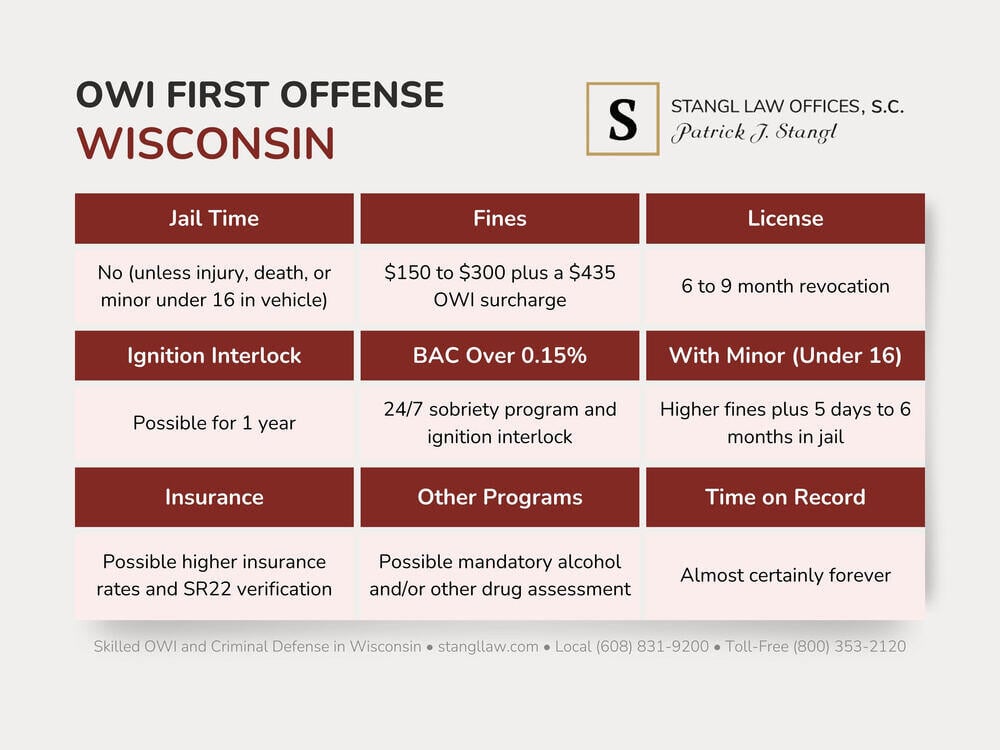
If an interlock device is ordered, your legal alcohol limit drops to 0.02 for the length of the order. One drink can put you over.
None of these penalties undo themselves. They are the floor for a first offense, and an attorney's job is to keep you from paying that floor, or to get the charge reduced so the floor never applies.
When a first offense OWI gets much worse
Certain facts turn a routine first offense into something far more serious, and some of them turn it into a crime. These are the situations where the gap between a good defense and no defense is the widest.
Table: First offense OWI penalties by situation. Figures are based on Wisconsin law as of 2026 and do not include the $435 surcharge unless noted.
If any of these apply to your case, the stakes are no longer about insurance and inconvenience. They are about your freedom. The earlier an attorney reviews the evidence, the more room there is to challenge how the case was built.
A serious charge needs a serious look at the evidence. High test results, a passenger under 16, or an accident can take a first offense from a fine to a felony. Stangl Law reviews the stop, the testing, and the police work for the errors that reduce or dismiss charges. Start with a free consultation below.
What a first OWI really costs
The fine on the ticket is the smallest part of the bill. When people add it all up, a first OWI commonly runs past $10,000 over the few years it follows them. Here is where the money goes.
-
Fines and the OWI surcharge: roughly $700 to $1,000 to start.
-
The required assessment and any treatment that comes out of it: hundreds to thousands of dollars.
-
SR-22 insurance: often two to three times your normal premium, for three years.
-
An interlock device, if ordered: around $1,000 or more per year, paid by you.
-
Towing and impound fees from the night of the arrest.
-
The cost of getting around for 6 to 9 months without a license, or the fees for an occupational one.
The money is real and recurring. The insurance hit alone outlasts the fine by years. That is part of why fighting the charge up front, when reduction or dismissal is on the table, tends to cost far less than living with a conviction.
The consequences that last for years
The license comes back, but the record does not. Wisconsin has no expungement for OWI, so a conviction is permanent and public. Even if you somehow got one expunged, the state Department of Transportation would not recognize it, and it would stay on your driving record anyway.
A first OWI can reach into parts of your life that have nothing to do with driving:
-
Jobs, especially anything involving driving, government work, healthcare, education, or finance.
-
Professional licenses for nurses, teachers, pilots, commercial drivers, and trades that require background checks.
-
Rental applications, since many landlords screen for impaired driving convictions.
-
Travel to Canada, which often turns away visitors with an impaired driving record.
-
Driving a company vehicle, which many employers ban for anyone with an OWI, even without a CDL.
This is the strongest argument for treating a first offense seriously from day one. The penalties end. The conviction is forever. Keeping it off your record is the entire point of mounting a defense before the case is decided. Talk to us.
Refusing the test
Wisconsin is an implied consent state. When you got your license, you agreed in advance to take a breath, blood, or urine test if an officer suspects impaired driving. Refusing has its own set of penalties, separate from the OWI itself.
For a first refusal, you face a one-year license revocation, a required interlock device for one year, and no occupational license for the first 30 days. Refusing a field sobriety test, the roadside walk-and-turn type, does not add a penalty, but the officer can use your refusal as evidence and may arrest you based on what they observed.
There is a tradeoff worth understanding. A refusal carries its own consequences, but it also leaves the prosecution with no test number to point to, which can make impairment harder to prove. Whether a refusal helps or hurts depends on the specifics of your case. The refusal hearing has the same short fuse as the suspension hearing: a written request to the court within 10 days of the notice.
A great attorney can tell you quickly whether and how to fight it.
Keeping your license to drive to work
Losing your license for most of a year is the consequence that disrupts daily life the fastest. Wisconsin offers a way to keep driving for the things you cannot skip: an occupational license. It lets you drive for limited approved purposes such as work, school, childcare, medical care, and treatment appointments.
-
To get one, you generally need to file proof of SR-22 insurance, pay the application fees (around $240), and complete your alcohol and drug assessment.
-
For a typical first offense with no prior record, you can usually apply right away. If you refused the test, there is a 30-day wait before you are eligible.
If you already hold an occupational license from the administrative suspension and are later convicted, the DMV will re-issue one for the length of your revocation, as long as you have no other license withdrawals, you meet any interlock requirement, and your revocation runs longer than six months.
The rules around occupational licenses trip people up, and one missed step can cost you weeks of driving. This is routine work for an OWI attorney, and getting it right early keeps you on the road.
Why first OWI cases are often winnable
An OWI charge can feel like a done deal. It rarely is. To convict you, the state has to prove that every part of the process was done by the book, and there are a lot of places where it commonly is not. A defense looks hard at each one:
-
Was the stop legal, with a real reason to pull you over?
-
Were the field sobriety tests given and scored correctly?
-
Was the testing equipment calibrated, certified, and used the right way?
-
Were blood or breath samples collected, handled, and stored properly?
-
Did the officer follow procedure and advise you of your rights?
-
Can the state show an unbroken chain of custody for any sample taken?
A failure on any one of these can lead to evidence being thrown out, and with it, a reduced charge or a full dismissal. People who fight their charges, rather than assuming the worst, often end up far better off than they expected.
Defenses that work
Every case is different, and the only way to know which defenses fit yours is to have an attorney look at the specifics of your arrest. These are some of the approaches that get first offenses reduced or dropped.
I wrote more about common OWI defense strategies here.
An illegal stop
Police cannot pull you over on a hunch. The Fourth Amendment requires a real reason: a warrant or reasonable suspicion that you broke a law. If the officer lacked that, the stop was unlawful and the evidence that came from it, including any breath result, may be thrown out. Without that evidence, the case can fall apart.
Field sobriety tests done wrong
These roadside tests follow strict rules. When an officer skips a step or scores them by feel, the results become unreliable and can be challenged. They are subjective to begin with, so they usually cannot carry a case on their own.
Mishandled blood samples
Blood drawn after an arrest has to be stored and processed a specific way. If the lab or the officer broke protocol, the result may be inadmissible, even if the number looks bad.
Medical conditions
Some health issues mimic impairment. Acid reflux and diabetes can throw off a breath test. Neurological conditions, injuries, or anxiety can make a sober person fail a roadside test. A defense can show that what looked like intoxication was something else.
Improper contact or rights violations
If a prosecutor contacted you without your attorney present after you asked for one, what you said may be inadmissible. Procedural slips like these can reshape a case.
The rising curve
Alcohol takes time to reach your blood. In some cases it can be shown that your level was still climbing while you were driving and was actually below the limit behind the wheel, only crossing it later at the station.
Calibration and equipment problems
A breath machine that was not calibrated correctly, or equipment that was not approved, gives the defense a way to challenge the result. Failing a breath test does not guarantee a conviction.
In the video below, I explain the importance of having the same training for field sobriety testing as law enforcement.
Find out which of these fits your caseThe defenses above only matter when someone applies them to the facts of your arrest. Attorney Patrick Stangl has spent more than three decades doing exactly that across Wisconsin. Tell him what happened in a free 10-minute call.
|
Myths that hurt people
The most damaging mistakes come from assumptions people make in the first few days. A few worth clearing up:
-
"A first OWI is basically a ticket." It's not. It can cost you a job, your license for most of a year, and over $10,000 once everything is added up, and it never comes off your record.
-
"I was under 0.08, so I am fine." You can still be convicted. If the court finds you could not drive safely on any amount of alcohol or drugs, the penalties are the same.
-
"You cannot lose your job over a first offense." You can. If your work involves driving, travel, or a company vehicle, a conviction can end it.
-
"It only applies to alcohol." No. A detectable amount of a restricted substance like marijuana or cocaine can bring an OWI charge on its own, with no alcohol involved.
-
"I can handle it myself."A first offense follows you for life, and a public defender will not be assigned to it. Handling it alone is the most expensive choice many people make.
What to expect on your court date
Your court date deals with the OWI charge itself, separate from the license hearing. The court can find you not guilty and dismiss the charge, or convict you on the OWI, the prohibited alcohol concentration, or the drug charge.
If you are convicted, your license is revoked, you complete the required alcohol and drug assessment and a Driver Safety Plan, and you are placed under an interlock requirement if your test was 0.15 or higher or you refused the test. The interlock restriction begins at conviction and runs until one year after you are issued an occupational license or get your regular license back.
Most of the work that changes this outcome happens before the court date, not at it. Filing motions to suppress bad evidence, challenging the stop, and pushing for a reduction all happen in the weeks beforehand. That is the window where cases are won.

Common questions about a first OWI in Wisconsin
-
"How long does a first OWI stay on my record?" For life. Wisconsin does not expunge OWI convictions, and the Department of Transportation keeps it on your driving record permanently. The only reliable way to protect your record is to keep the conviction from happening, which is why people fight to reduce or dismiss the charge with the help of an experienced OWI attorney.
- "Can a first OWI be reduced or dismissed?" Yes. It happens regularly, actually. An unlawful stop, flawed roadside tests, mishandled samples, or a rights violation can lead to a reduced charge, often reckless driving, or a full dismissal. The sooner an attorney reviews your case, the more options exist.
- "Will I go to jail for a first offense?" Not for a standard first offense. Jail becomes possible only when there was a child under 16 in the car, or the OWI caused injury or death.
- "What is the prohibited alcohol concentration?" It's the legal limit. For a first, second, or third offense it is 0.08. It drops to 0.02 for a fourth or later offense, and for anyone driving under an interlock order. A prohibited alcohol concentration charge is filed in addition to the OWI charge.
- "What is an SR-22?" It's not insurance. It's a form your insurance company files with the state to prove you carry coverage. After an OWI you have to keep it on file for at least three years. Not every insurer offers it, and the ones that do usually charge much higher rates.
- Can I get an OWI for driving after using marijuana? Yes. A detectable amount of a restricted controlled substance in your blood can bring an OWI charge under Wisconsin law, whether or not you show any sign of impairment. As of March 2026, law enforcement officers can now use roadside saliva tests during traffic stops to screen drivers for drugs. More on that here.
- "What happens if I have an out-of-state license?" It usually gets more complicated. States share this information, so a Wisconsin OWI can trigger penalties from your home state as well, on top of what Wisconsin imposes.
- Does a prior OWI from years ago count? If your only prior OWI was more than 10 years ago, a new charge is generally treated as a first offense. Once you have two or more, Wisconsin counts them for life, no matter how old.
- "What does it cost to refuse the test?"A first refusal brings a one-year revocation, a one-year interlock requirement, and no occupational license for the first 30 days. You have 10 days to request a hearing to fight it.
What working with Stangl Law looks like
Attorney Patrick J. Stangl has defended OWI cases across Wisconsin since 1991, in both state and federal courts. Here is how a first offense case typically moves, although it can look different based on your circumstances.
Take the first step todayIf you are facing a first OWI in Wisconsin, the most useful thing you can do right now is talk to someone who handles these cases every day. Attorney Patrick J. Stangl offers a free 10-minute consultation, with no obligation, to look at your situation and explain your options. The 10-day deadline does not wait, so neither should you.
|
FREE 10-Minute Legal Consultation
Nationally recognized OWI Defense Attorney Patrick J. Stangl has over 32 years of experience protecting the rights of clients accused of OWI across Wisconsin.
If you're facing OWI charges in Wisconsin, including drug charges or repeat OWI charges, click below to request a FREE 10-minute consultation to discuss your drunk driving or driving under the influence case and help explore options for your defense.
In the video below, I introduce myself and my practice.
Madison OWI Attorney Patrick J. Stangl, is committed to exploring options for your best defense and has defended clients across the state since 1991. To this end, he is pleased to offer a FREE 10-minute consultation at no obligation to discuss the specifics of your case and take the first step in putting this stressful time behind you.

Stangl Law Offices, S.C.